
Why Your Business Gets Leads but No Sales: Causes and Solutions
You are spending on ads, your phone is ringing, and your CRM or WhatsApp is full of enquiries. But at the end of the month, very few of those leads turn into paying customers. If this sounds familiar, you are not alone, and the good news is that this problem is usually fixable.
The short answer: Businesses get leads but no sales because of a mismatch somewhere in the journey. The leads may be low-quality, the offer may be unclear, follow-up may be slow, or the sales process may not build enough trust. This guide shows you how to find the exact leak and fix it.
Lead vs Sale: Where the Problem Actually Sits
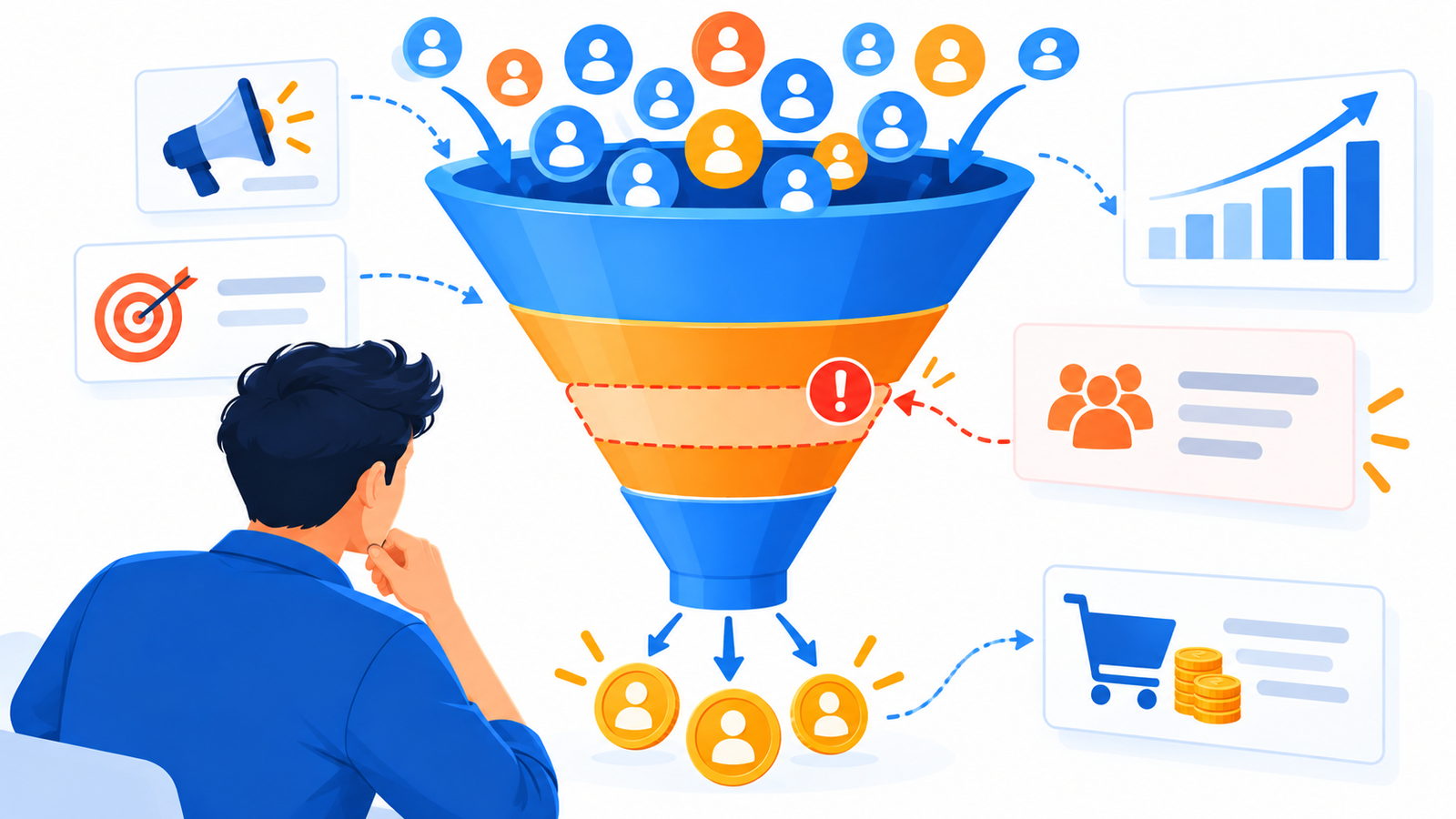
Before changing anything, understand that a lead is only an expression of interest. A sale needs trust, price fit, timing, and a good conversation. Your funnel has four layers, and the leak is in one of them:
- Traffic and targeting: Are the right people seeing your ad?
- Offer and landing page: Is the promise clear and believable?
- Lead qualification: Are you filtering serious buyers from casual enquirers?
- Follow-up and closing: Are leads contacted fast, and does the conversation lead to a decision?
7 Common Reasons You Get Leads but No Sales
1. You are attracting the wrong audience
Broad targeting, “easy” lead forms, or ads built around freebies bring people who are curious but not ready to buy. A real estate or coaching business, for example, may get many enquiries from students or people just comparing options.
Fix: Narrow your targeting by location, intent, and budget level. Use ad copy that filters, such as mentioning the price range or who the service is not for.
2. Your offer is unclear or not compelling
If people don’t understand what you sell, the price, or why you are better, they will enquire out of curiosity and then disappear.
Fix: State the offer, who it’s for, and the next step in plain language. Add proof you genuinely have, such as real reviews, real work samples, and real photos.
3. Your lead form or landing page attracts low-intent leads
Very short forms (just name and number) generate volume but low quality. Pages that overpromise create disappointment on the first call.
Fix: Add one or two qualifying questions, such as budget range, timeline, or city. You may get fewer leads, but better ones.
4. Follow-up is slow or inconsistent
Leads cool down fast. If an enquiry from the morning gets a call the next evening, the buyer has probably already spoken to a competitor.
Fix: Set a clear response-time rule (for example, first contact within minutes during business hours), and track who contacted which lead and when. Use a simple CRM or even a shared sheet.
5. There is no lead qualification process
Your team may treat every lead equally and waste time on people who can’t buy.
Fix: Score leads with a basic checklist:
- Do they need it now?
- Can they afford it?
- Are they the decision-maker?
- Are they in your service area?
6. Sales conversations don’t build trust
Even good leads drop off if the call is rushed, pushy, or doesn’t answer objections like price, trust, and results.
Fix: Create a short call script with common objections and answers. Share proof after the call over WhatsApp. Record and review a few calls each week.
7. Marketing and sales don’t share feedback
The ad team optimizes for cheap leads, while the sales team complains the leads are bad. Nobody connects the two.
Fix: Send sales outcomes (qualified, visited, purchased) back to the marketing team every week. Optimize for cost per sale or cost per qualified lead, not just cost per lead.
How to Find Your Leak: Simple Funnel Math
Track these numbers for the last 30 days:
| Stage | Example question |
|---|---|
| Leads received | How many enquiries came in? |
| Contacted within the target time | How many got a quick response? |
| Qualified | How many were genuinely interested and fit? |
| Meetings / demos / quotes | How many reached a real discussion? |
| Sales | How many paid? |
Illustration only (hypothetical numbers): if 100 leads give 40 qualified and 10 sales, but only 30 of the 100 were contacted promptly, your biggest leak is follow-up speed, not the ads. Fix that before increasing budget.
Mistakes to Avoid
- Judging campaigns only by cost per lead
- Increasing ad budget before fixing the funnel
- Blaming the platform without checking follow-up
- Ignoring leads that were not ready yet (use a nurture plan)
- Having no tracking, so you don’t know which source gives buyers
Realistic Expectations
Lead-to-sale rates vary widely by industry, ticket size, and sales cycle. A low-ticket D2C product, a high-ticket service, and a local clinic will all look different, so compare your numbers against your own past performance rather than a generic benchmark. Improvement is usually gradual and comes from testing one change at a time.
A 7-Day Action Plan
- Day 1: Collect the last 30 days of lead and sales data.
- Day 2: Map where leads drop off.
- Day 3: Review your ad copy and landing page for clarity and filtering.
- Day 4: Add qualifying questions to your lead form.
- Day 5: Set a follow-up rule and an owner for each lead.
- Day 6: Write call scripts and objection answers.
- Day 7: Start a weekly marketing-sales review.
Need Help With Leads That Don’t Convert?
ICONICMONEY helps businesses improve their digital marketing through Meta Ads, Google Ads, and lead generation strategies built around qualified leads, not just cheap enquiries. Get in touch to discuss your goals and explore a strategy suited to your business.
D. FAQ Section
1. Why do I get leads but no sales?
Usually because of low lead quality, an unclear offer, slow follow-up, or a weak sales conversation. Review each funnel stage to find where leads drop off.
2. What is a good lead-to-sale conversion rate in India?
There is no single number. It depends on your industry, price point, and sales cycle. Track your own baseline and improve against it.
3. Can Meta Ads or Google Ads bring bad leads?
Yes, if targeting is too broad, the form is too easy, or the ad overpromises. Better filtering and tracking sales outcomes improve lead quality.
4. How fast should I follow up on a new lead?
As fast as practical. Faster follow-up generally improves your chance of a conversation, so set a response-time rule for your team.
5. Should I optimize for cost per lead or cost per sale?
Cost per lead is a starting metric. Cost per qualified lead and cost per sale show whether marketing actually grows revenue.
6. Is my sales team or my ad campaign the problem?
Check both. If leads are contacted late or poorly, it’s the process. If leads don’t match your buyer at all, it’s targeting or offer.

1 Comment
Your comment is awaiting moderation.
Вызов начинается с обращения по телефону. Оператор принимает заявку, уточняет адрес и состояние человека. Далее организуется выезд нарколога. Врач приезжает на дом с медицинским оборудованием и препаратами, проводит первичный осмотр и выбирает безопасное лечение. Диагностика включает оценку пульса, давления, дыхания, уровня сознания и симптомов интоксикации.
Получить больше информации – врач нарколог на дом в Луганске
[…] Tracking is what makes Meta ads for builders accountable. Most builders stop measuring at the lead. Instead, tag every lead in your CRM with a stage: contacted, qualified, site visit, negotiation, booked. Feed that data back into your reporting so you can see which campaigns bring buyers rather than names. If your campaigns produce leads but few bookings, read our guide on leads but no sales. […]