E-commerce Marketing Services in India: A Complete Guide
You launch a store, spend on ads, and the orders come in. A month later, the numbers don’t add up. Returns are high, cash-on-delivery parcels are bouncing back, and what the ad dashboard calls profit doesn’t match your bank balance.
This is a common story for Indian online sellers. This guide explains what e-commerce marketing services in India actually include, which ones matter at each stage, what to budget, and how to pick a partner who cares about profit, not just clicks.
What Are E-commerce Marketing Services?
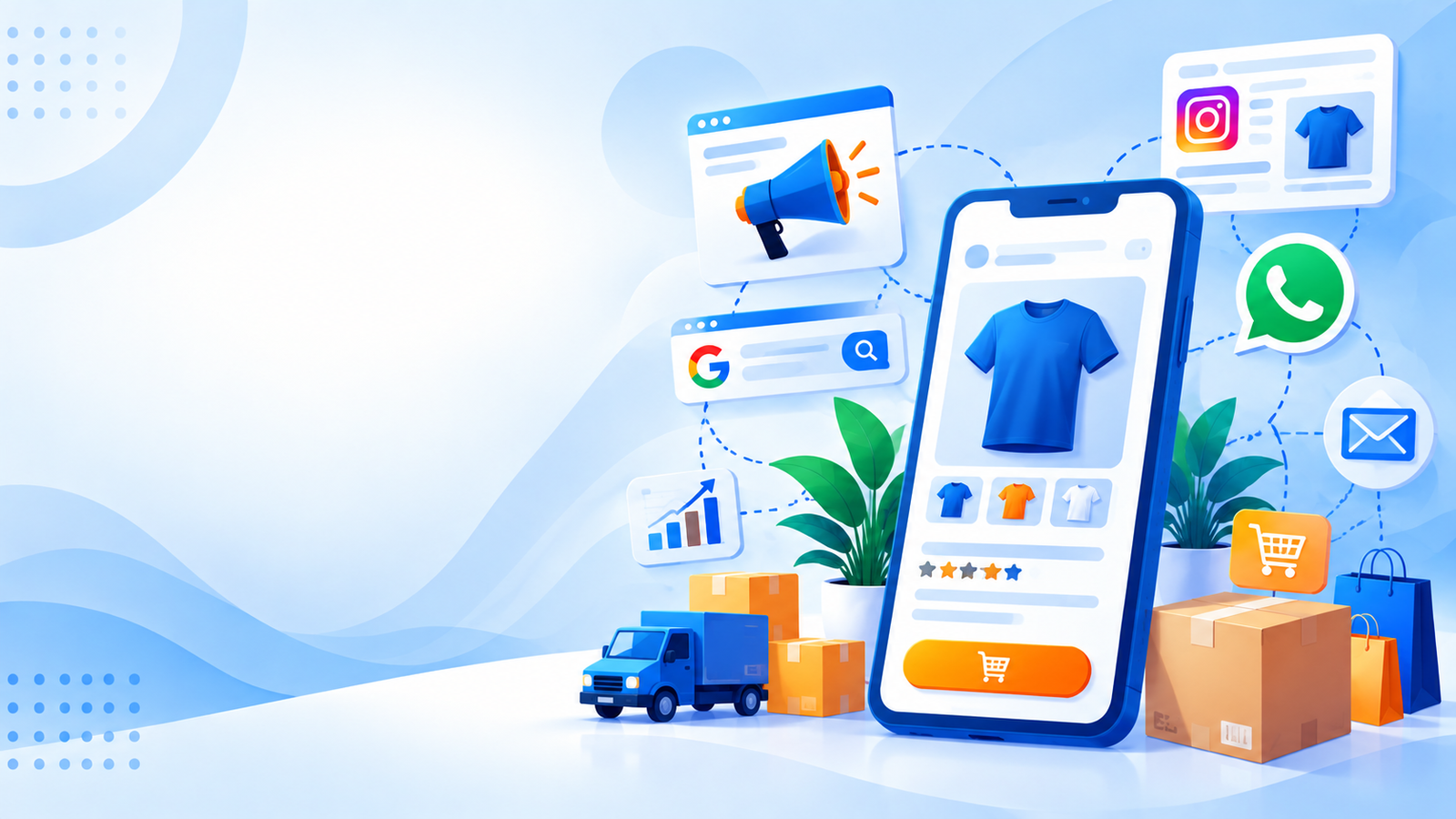
E-commerce marketing services help an online store attract the right shoppers, convert them into orders and bring them back to buy again. A full-service partner typically covers:
| Service | What it does |
|---|---|
| Meta Ads (Facebook and Instagram) | Finds new buyers with product and catalog ads, creatives and retargeting |
| Google Ads | Captures people searching for your products through Search, Shopping and Performance Max |
| Marketplace advertising | Promotes listings on platforms where your shoppers already browse |
| E-commerce SEO | Helps category and product pages appear in organic search |
| Conversion rate optimisation (CRO) | Improves product pages, checkout and mobile experience |
| Email and WhatsApp marketing | Recovers abandoned carts, announces offers, drives repeat orders |
| Creative and content | Product photos, short videos, ad copy and landing pages |
| Analytics and reporting | Tracks orders, costs and profit across channels |
You rarely need all of these at once. The skill is in choosing the right few for your stage.
The Short Answer: What Should You Spend?
Costs have three parts:
| Cost component | What it covers |
|---|---|
| Ad spend | Money paid to Meta, Google or marketplaces |
| Service fee | Strategy, setup, management and reporting |
| Supporting costs | Creatives, store improvements, email and WhatsApp tools, tracking |
Agencies usually charge through a flat monthly retainer, a percentage of ad spend, a hybrid of the two, or a one-time setup. Fees vary a great deal by agency, scope and city, so always ask for a written breakdown.
Many store owners compare fees and forget the real budget driver: ad spend and creative production. A low fee with a tiny ad budget won’t produce growth, and a big ad budget with weak tracking burns money.
Why Indian E-commerce Marketing Is Different
Global advice doesn’t always fit. Keep these local realities in mind:
- Cash on delivery (COD) is still common, especially outside metros. COD can lift conversions but also brings failed deliveries and returns.
- Returns to origin (RTO) eat margin. Every parcel that comes back costs you shipping both ways and sometimes damaged stock.
- Mobile-first shoppers. Most browsing happens on phones, often on average connections. Slow pages lose orders.
- WhatsApp is a primary channel. Many shoppers want to ask questions or confirm orders there.
- Festive and wedding seasons create spikes. Plan stock, creatives and budgets weeks ahead.
- Tier 2 and Tier 3 cities matter. Language, trust signals and payment preferences differ from metro buyers.
Stop Judging Campaigns by ROAS Alone
ROAS (return on ad spend) shows revenue divided by ad spend. It ignores product cost, shipping, returns and fees. A campaign can show a healthy ROAS and still lose money.
Worked example (hypothetical, simplified, for illustration only)
Imagine 100 orders placed in a month, each worth ₹1,000:
| Item | Amount |
|---|---|
| Orders placed (booked revenue ₹1,00,000) | 100 |
| Orders returned or refused (assumed 25%) | 25 |
| Orders delivered, revenue kept | 75 → ₹75,000 |
| Product cost on delivered orders (assumed 40%) | ₹30,000 |
| Shipping, forward on 100 orders and reverse on 25 (assumed ₹80 each way) | ₹10,000 |
| Ad spend at a reported ROAS of 3x on booked revenue | ₹33,333 |
| Left over before overheads | about ₹1,667 |
The dashboard says 3x. The business is barely breaking even before paying for staff, tools, packaging or the agency fee. These numbers are invented to show the method. Use your own costs.
Track these instead:
- Contribution margin per order after product cost, shipping, returns and fees
- Profit on ad spend, meaning gross profit divided by ad spend
- Customer acquisition cost against repeat purchase value
- RTO rate by city, pincode and payment type
Core E-commerce Marketing Strategies
1. Get the foundation right first
Before spending on ads, check:
- Fast, mobile-friendly store with clear product pages and reviews
- Working tracking: Meta Pixel and Conversions API, Google tag, purchase events
- Clean product feed and product data
- Clear shipping, return and COD policies
- Trust signals: contact details, reviews, secure payment badges
A store with weak product pages wastes every rupee of ad spend. If your site needs work, treat that as your first marketing investment.
2. Meta Ads for discovery
Meta suits brands where visuals sell the product: fashion, beauty, home, food, gifting. Use short videos and clear offers, test several creatives, and retarget visitors who viewed products or added to cart.
- Strength: reach and storytelling for products people didn’t know they needed.
- Watch out for: creative fatigue. Refresh ads regularly.
3. Google Ads for demand that already exists
When someone searches “cotton kurta set under 1500,” Google Shopping and Search ads can put your product in front of them. Performance Max can also help once your feed and tracking are solid.
Google also shows free product listings for eligible stores in India when products are submitted through Merchant Center, so a clean feed helps both paid and unpaid visibility.
- Strength: high purchase intent.
- Watch out for: poor product titles and feed errors, which limit reach.
4. E-commerce SEO
Organic search brings steady traffic over time. Focus on:
- Category pages with useful descriptions, not just product grids
- Clear product titles and unique descriptions
- Internal links between related categories
- Helpful guides: size charts, buying guides, comparison pages
Expect months, not weeks. SEO suits brands thinking beyond the next sale.
5. WhatsApp and email for retention
It usually costs less to sell again to an existing customer than to win a new one. Useful flows include:
- Abandoned cart reminders
- Order confirmation and delivery updates
- COD confirmation messages to reduce fake or impulse orders
- Re-order reminders for consumables
- Offers for repeat buyers
Always get clear consent before marketing messages. India’s data protection rules are being phased in, so keep opt-in records and a simple opt-out.
6. Conversion rate optimisation
A small lift in conversion often beats a big increase in ad budget. Test:
- Product page images, video and review placement
- Pricing and offer clarity
- Checkout steps and payment options
- Prepaid incentives to nudge COD buyers toward online payment
- Page speed on mobile
7. Cutting RTO
You can’t remove returns, but you can reduce them:
- Confirm risky COD orders by call or WhatsApp
- Offer a small prepaid discount
- Verify addresses and pincodes
- Track RTO by city and pause ads in consistently poor areas
- Choose couriers based on delivery performance in your target pincodes
Which Services Do You Need? A Decision Framework
| Your stage | Focus on first | Add next |
|---|---|---|
| Just launched, few orders | Store basics, tracking, one acquisition channel | Email and WhatsApp basics |
| Validating, orders are steady | Creative testing, product pages, retargeting | Second channel, COD and RTO controls |
| Scaling | Profit-based reporting, catalog and Shopping campaigns, retention flows | SEO, influencer partnerships, marketplace ads |
Ask one question at every stage: what is the biggest leak in my funnel? If shoppers visit but don’t buy, fix the store. If they buy but don’t return, fix retention. If orders come but profits don’t, fix unit economics.
How to Choose an E-commerce Marketing Agency
Ask these before signing:
- Do you report on profit and RTO, or only on ROAS?
- Which channels will you start with for my products, and why?
- Who owns the ad accounts, pixel and product feed? (You should.)
- How will tracking be set up and verified?
- What is included in your fee? What is excluded?
- How do you decide creative direction and how often will new creatives arrive?
- How often will I get reports, and can I see raw data?
- What is the contract length and exit process?
Red flags:
- Guaranteed ROAS or guaranteed sales
- No access to your own accounts
- Reports with only impressions, clicks and ROAS
- No questions about your margins, returns or COD share
- Long lock-in before any test
Common Mistakes to Avoid
- Scaling ad spend before the product page converts
- Ignoring COD and RTO until cash runs short
- Running too many channels with too little budget
- Changing everything weekly, which hides what works
- Treating every order as profitable
- Skipping retention, then paying again for the same customers
A Simple 90-Day Plan
Days 1–15: Foundation. Fix tracking, product feed and key product pages. Define your margin per product and your target cost per order.
Days 15–45: Test. Launch one or two channels with a few creatives each. Track orders, RTO and contribution margin, not just ROAS.
Days 45–90: Improve and expand. Keep what works, cut what doesn’t, add retargeting and WhatsApp or email flows, then consider a second channel.
Need help turning store traffic into profitable orders?
ICONICMONEY helps businesses improve their digital marketing through Meta Ads, Google Ads, e-commerce growth and conversion optimisation. Get in touch to discuss your goals and explore a strategy suited to your business.
CTA Button Text: Get a Free E-commerce Marketing Audit
Conclusion
The best e-commerce marketing services in India don’t just bring clicks. They help you understand what each order really earns after returns, shipping and product cost, and they build the foundation, acquisition and retention that make growth sustainable.
Start by fixing the biggest leak in your funnel. Measure profit, not just ROAS. Choose a partner who is open about reporting, and give each channel enough time and budget to teach you something before you scale.
D. FAQ section
Frequently Asked Questions
1. What do e-commerce marketing services include?
They usually include paid ads (Meta, Google, marketplaces), e-commerce SEO, conversion optimisation, email and WhatsApp marketing, creatives and reporting. The right mix depends on your stage and margins.
2. How much do e-commerce marketing services cost in India?
Costs combine the agency fee, ad spend and supporting costs such as creatives and tools. Fees vary by agency and scope, so ask for a written breakdown and a clear definition of what is included.
3. Which is better for an online store: Meta Ads or Google Ads?
Meta helps you reach people who haven’t searched yet, which suits visual or impulse products. Google reaches people actively searching, which suits products with clear search demand. Many stores test one first and add the other.
4. Why is my ROAS good but my business isn’t profitable?
ROAS ignores product cost, shipping, returns, COD failures and fees. Track contribution margin per order and profit on ad spend to see your true result.
5. How can I reduce RTO in e-commerce?
Confirm risky COD orders, encourage prepaid payments, verify addresses, track RTO by pincode and pick couriers that perform well in your target areas.
6. Can an agency guarantee sales for my e-commerce store?
No. An agency can set up, test and optimise campaigns, but results also depend on your product, price, store experience, competition and operations. Be cautious about guarantees.